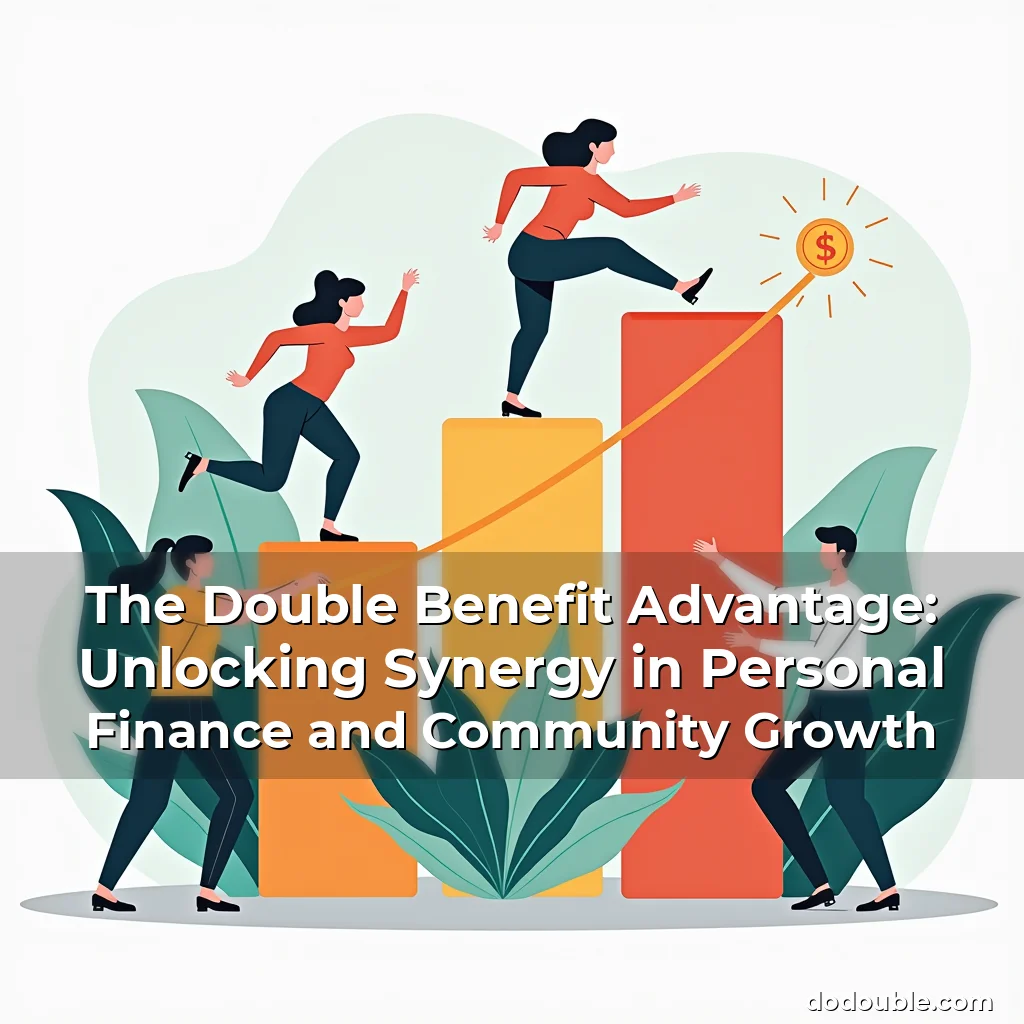
The Double Benefit Advantage: Unlocking Synergy in Personal Finance and Community Growth
In an era where financial efficiency meets social impact, the concept of “double benefit” has emerged as a powerful framework that aligns personal wealth creation with broader societal gains. This strategy enables individuals and communities to achieve financial growth while simultaneously contributing to meaningful causes.
The synergy between economic progress and social responsibility is not only possible but increasingly essential in today’s interconnected world. By embracing double benefit principles, participants can transform traditional transactional relationships into mutually reinforcing partnerships that drive sustainable change.
Understanding the Core Principles of Double Benefit
The foundation of any successful double benefit initiative lies in its ability to create value across two distinct domains simultaneously. At its core, this approach recognizes that every financial decision carries both individual and collective implications.
This dual-value model operates by identifying opportunities where monetary returns are intrinsically linked to positive externalities. Whether through investment choices or consumption patterns, these synergies allow stakeholders to pursue their goals without compromising communal well-being.
- Economic Returns: Traditional profit generation remains central to the equation, ensuring viability and sustainability.
- Social Impact: The secondary dimension focuses on measurable benefits such as environmental preservation or community development.
The Evolution of Double Benefit Concepts
Historically, charitable giving and commercial ventures existed in separate spheres, each pursuing different objectives. However, modern innovations have bridged this gap through hybrid models that integrate philanthropy within business operations.
Pioneering organizations have demonstrated that profitability and purpose need not be mutually exclusive. From socially responsible investing to fair trade initiatives, various frameworks now enable simultaneous achievement of financial and ethical goals.
Diverse Applications Across Industries
The versatility of double benefit strategies allows them to thrive in numerous sectors. In finance, impact investing channels capital toward enterprises addressing global challenges while delivering market-rate returns.
Retail businesses implement circular economy practices that reduce waste and generate revenue from repurposed materials. These examples highlight how diverse industries can adopt tailored approaches to realize mutual advantages.
Casual Consumer Engagement
A growing number of consumers actively seek brands that embody double benefit values. Market research indicates that over 68% of millennials prioritize companies demonstrating social consciousness when making purchase decisions.
This shift reflects changing consumer expectations, where ethical considerations influence spending habits significantly. Businesses recognizing this trend incorporate sustainability metrics into product offerings to meet evolving demands.
Financial Mechanisms Enabling Double Benefits
Several innovative financial instruments facilitate the realization of double benefit outcomes. Socially responsible investment funds screen portfolios based on ESG criteria, directing capital towards enterprises committed to both profit and planet.
Bond markets also offer tools like green bonds, which fund environmentally friendly projects while providing investors with fixed income streams. These mechanisms demonstrate how traditional financial systems can evolve to support shared value creation.
Community-Based Implementation Models
Local communities play a crucial role in implementing double benefit solutions at grassroots levels. Cooperative structures empower members to collectively manage resources while reinvesting profits back into the neighborhood.
These bottom-up approaches often yield greater resilience compared to top-down implementations. When residents directly participate in decision-making processes, they cultivate stronger ownership and commitment to shared objectives.
Microfinance and Financial Inclusion
Microfinance institutions exemplify effective double benefit implementation by offering small loans to underserved populations. While generating interest-based income, they simultaneously expand access to formal banking services.
Data shows that microloans contribute to poverty reduction by enabling entrepreneurship among marginalized groups. For instance, Grameen Bank’s model has lifted millions out of poverty through targeted lending programs.
Measuring Success in Double Benefit Initiatives
Evaluating the effectiveness of double benefit efforts requires balanced assessment metrics that consider both financial performance and social impact indicators. Traditional ROI calculations must be complemented with qualitative measures tracking long-term benefits.
Impact measurement frameworks help quantify non-financial contributions, such as improved education rates or reduced carbon emissions. These assessments ensure transparency and accountability in achieving stated objectives.
Challenges and Considerations
While promising, implementing double benefit strategies presents several challenges that require careful navigation. Balancing immediate financial needs with long-term social goals often creates tension within organizational structures.
Authenticity concerns arise when businesses engage in superficial CSR activities rather than integrating social value into core operations. Distinguishing genuine commitments from marketing tactics becomes critical for maintaining credibility.
Fostering Cultural Shifts Toward Shared Value
Cultural transformation plays a vital role in sustaining double benefit practices over time. Educational campaigns highlighting success stories can inspire wider adoption of these integrated approaches.
Leadership commitment proves essential in embedding shared value principles within corporate DNA. When executives genuinely endorse these values, they set the tone for organizational culture and employee engagement.
Global Perspectives and Cross-Border Opportunities
The double benefit concept transcends geographical boundaries, finding expression in various cultural contexts worldwide. International collaborations enable knowledge exchange and resource sharing across different regions.
Developing nations particularly stand to gain from cross-border partnerships that combine foreign expertise with local insights. Such alliances can accelerate progress toward common developmental goals while respecting regional nuances.
Future Trends and Innovations
Emerging technologies promise to enhance the scalability and precision of double benefit initiatives. Blockchain applications provide transparent tracking of social impact investments, increasing investor confidence.
Artificial intelligence analytics can optimize resource allocation by predicting areas most likely to yield combined financial and social returns. These advancements suggest a future where impact generation becomes even more efficient and data-driven.
Conclusion
The double benefit paradigm offers a transformative approach to reimagining our relationship with money and society. It demonstrates that prosperity does not have to come at the expense of communal welfare.
By adopting this mindset, individuals and organizations can become agents of positive change while still achieving their own financial aspirations. Embracing double benefit principles empowers us to build a more equitable and sustainable future for generations to come.